
The Wingo Signal Guide
The 92Jeeto Hack puts a lot of information on one small card. This guide teaches you to read all of it — the lean, the confidence meter, the window size — and to build the session habits that separate calm users from frazzled ones.
Anatomy of a signal card
Strip the styling away and every card carries five pieces of information. Learn what each one is for and the card stops being a number and becomes a briefing.
The room tag anchors everything — it names the timer room this forecast belongs to, because a 1-minute read tells you nothing about the 3-minute room. The lean is the headline call: which side of Big/Small the engine favours. The colour line reports where the green/red wave stands and whether violet spacing deserves a glance. The confidence percentage grades the internal agreement behind the call. And the window size tells you how much history the engine examined — 100-something rounds or 500-something — which is quietly the most underrated number on the card.
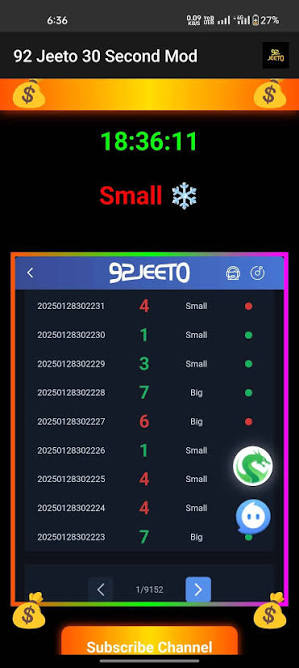
One habit before the rest: read the card top to bottom once, completely, before reacting to the lean. Players who fixate on the arrow and ignore the metadata are reading headlines and skipping the article — and the metadata is where the judgment lives.
The confidence meter, properly understood
The confidence percentage is the most misunderstood feature in the app, so let’s define it precisely. Behind every forecast sit several pattern families — runs, rhythms, colour drift, number spread. Each votes on the next outcome. Confidence measures how much those independent votes agree.
When runs analysis, switch-rhythm timing and colour drift all point the same way, confidence climbs — and historically, those aligned forecasts have corresponded to better outcomes than coin-flip reads. But here’s the sentence that must come next: agreement improves the odds, it does not purchase the outcome. A 78% card can miss; a 41% card can land. Confidence is a long-run statistic, and any single round is allowed to defy it.
Practically, that converts into a personal threshold. Pick a confidence floor — many thoughtful users sit around the upper half of the scale — and let cards below it pass without a flicker of regret. The app prints signals for every round; nothing obliges you to care about every round. Selectivity is not timidity. In a fast game, skipping is the cheapest skill there is.
Window sizes: what 100 vs 500 is telling you
Unlike classic predictors with a frozen sample size, the 92Jeeto Hack flexes its analysis window between 100 and 500 rounds, and the two drivers are worth internalising. Server load sets the ceiling: when the platform is slammed, a leaner window keeps signals arriving on schedule instead of lagging past the timer. Model confidence sets the target: when the read on the room is crisp, a tight window of 100–300 rounds is faster and more reactive; when the read is murky, the engine deliberately widens toward 500 so weak patterns face more evidence before a card prints.
So the window size is a mood indicator. A run of tight windows means the engine sees clean, decisive structure. A drift toward deep windows means the room has turned ambiguous — the engine is doing more homework before committing, and arguably you should too. Ambiguity is information; the card tells you when the game itself has gone murky.
Beginners can ignore this number for their first week and lose nothing. But once reading it becomes automatic, the window becomes the difference between “what does the engine say” and “how sure is the engine right now” — and the second question is the sharper one.
When signals agree — and when they argue
The size lean and the colour line are separate reads that usually cooperate. When they don’t, the card is arguing with itself, and those disagreements are worth your attention in both directions.
Agreement — a Big lean plus a colour wave that supports the same half of the board — is the classic high-quality setup: independent analyses converging on one story. These cards earned their confidence, and they’re the ones selective users wait for. Conflict — strong size read, hesitant or opposing colour read — usually means the room is mid-transition: one pattern ending while another forms. The engine still prints its best guess, but mid-transition rooms are where surprises cluster, and the confidence meter typically sags accordingly.
The refined move is treating the card as a panel, not an oracle: when the panel agrees, consider acting; when the panel splits, consider waiting one round to see which read survives. Waiting costs one round. Acting into a split costs more when it goes wrong — and it goes wrong precisely then, more often than anyone enjoys admitting.
Room speed changes signal behaviour
Same engine, four different tempos — and the signals inherit the tempo. In the 30-second room, cards arrive faster than reflection: confidence swings are sharper, patterns flip quickly, and the whole mode rewards a settled routine over deliberation. It’s the room for people who already know their thresholds cold.
The 1-minute room is the natural habitat for most users — enough spacing to read the full card, enough pace to stay engaged; it’s where confidence calibration happens fastest. The 3-minute room gives patterns time to actually form between signals: fewer cards, steadier reads, ideal for learning window-size behaviour. The 5-minute room is the slowest, most deliberate pool the app covers — long-cycle patterns become visible and the engine’s deepest windows do their clearest work.
If you’re calibrating yourself, do it in one room and stay there a while. Confidence numbers feel different at different speeds, and mixing rooms while learning muddies your internal benchmarks. Graduate when the card-reading is automatic, not when boredom arrives — boredom is cheaper than confusion.
A session routine that holds up
Tools don’t protect people; routines do. The one below is unexciting on purpose — it’s the shape most long-term users converge on, and it survives bad nights.
-
Decide before you open
Session length and limits get chosen in advance, on purpose, while calm. Decisions made mid-session inherit mid-session emotions — which are the worst advisors in the building.
-
Glance at the road yourself
Ten seconds on the raw history table before the first card. If your eyeball read screams against the engine’s, take that seriously — disagreement between you and the model is a reason to watch a round, not a debate to win.
-
Filter, then act
Only cards above your confidence floor, only when the panel agrees. Flat, level participation every time — never bigger after misses. Escalating to “recover” is how a bad hour becomes a bad week.
-
Close the loop
Stop at the limit you set. Optionally, spend two minutes noting which pattern families drove the cards you followed — that review is where personal calibration actually compounds.
The standing rule: signals are probabilistic guidance, never certainties — the app is not 100% and no honest tool could be. Outcomes are uncertain and losses are possible. We are not responsible for any losses. 18+ only. Treat this as entertainment that happens to think for a living.
Signal guide mini-FAQ
What’s a good confidence floor to start with?
Begin in the upper half of the scale and adjust with experience. The exact number matters less than having one — a fixed floor converts the app from a noise stream into a filter.
Do colour leans matter as much as size leans?
They’re complementary reads. Colour waves move slower and carry context; size leans react faster. The best setups are when both tell the same story.
Should beginners avoid the 30-second room?
Generally, yes — not because the signals are worse, but because the pace punishes inexperience. Learn calibration at 1 or 3 minutes, then speed up if you enjoy it.
For what the engine can and can’t honestly deliver, read the accuracy page. For the app itself, the download page is one click away.
Now read the real cards
The guide ends where the app begins — download it free and put chapters one to six into practice.
Disclaimer: This guide describes a prediction-assistance app that is not 100% accurate. Forecasts can be wrong; outcomes are uncertain; losses are possible. We are not responsible for any losses. For adults 18+ only. Engage responsibly.